Universal Church of Harmony
Last and First MenThe Universal Church of Harmony was founded after a monarch adopted the prophet’s music-centered faith and used its popular force to remake political rule. The church united the world under a religious order that treated each person as a melody within a greater social composition; its history also turns on a sharp contradiction, as the prophet was imprisoned and his teaching made useful to the authorities.
Doctrine and popular appeal
The faith behind the church began with the prophet’s claim that music, not the material world, was reality: each living being had a body that would perish and a musical soul that could endure. Because melodies cease and can nonetheless sound again, he taught that music’s apparent transience revealed an existence beyond time. Individuals could aspire to eternal life by awakening their souls into melody and harmony, with their standing depending on their musical originality and skill.
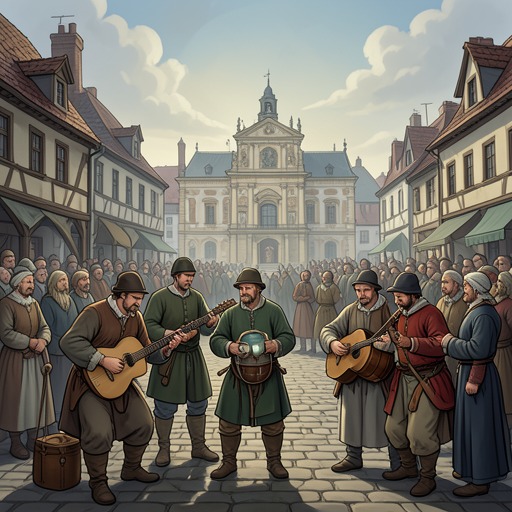
The doctrine and the prophet’s impassioned music spread rapidly. Instrumental and vocal performances sounded across pastures and cultivated land, challenging a social order that privileged aristocratic birth and established musical forms. The new faith instead gave priority to spontaneous emotional expression in rhythm and harmony. The government tried to suppress it, in part because it believed the music interfered with agricultural productivity and in part because its emotional force threatened the refinement of the court. Persecution strengthened the movement rather than extinguishing it.
Foundation and capture of the faith
The decisive political turn came when the sacred monarch declared himself converted. The conversion was presented as partly sincere and partly strategic; what followed was a transfer from bureaucracy to enlightened dictatorship. The monarch took the title Supreme Melody, and the social order was reshaped to suit the peasants’ faith. Backed by popular crusading zeal, and aided by the religion’s rapid spread across lands, he conquered the world and founded the Universal Church of Harmony.
The prophet did not become the church’s governing head. Dismayed by the ease of his success, he had withdrawn to the mountains to develop his art in quiet. The emperor sent military bands and church choirs to bring him to the capital. After a struggle, the prophet was taken to the High Temple of Music, kept as a prisoner, and used by the world-government as an oracle whose utterances required interpretation. The temple’s official music and visiting delegations eventually drove him into madness; in that condition, he was considered more useful to the authorities. The contrast between the faith’s liberating popular appeal and the prophet’s confinement exposes how completely its political sponsors could appropriate the movement.
World rule and legal order
The Universal Church of Harmony founded the Holy Empire of Music, which gave order and purpose to the species for a thousand years. The prophet’s sayings, interpreted by successive rulers, became the basis of a comprehensive legal system. Its authority gradually displaced local codes, not through a detailed account of the church’s offices or administration, but through the claim that the new law carried divine sanction.
That law was described as intricate common sense decorated with harmless and precious flowers of folly. In practice, its underlying conception treated individuals as biological organisms with definite needs, rights, and social obligations. The church’s distinctive language recast those claims as a musical ideal: each person was a melody requiring completion within the larger theme of society. Music thus supplied both a metaphysical account of personal worth and a vocabulary for integrating individual lives into a universal social order.
Significance and contradiction
The church’s achievement was to turn an initially insurgent faith into the common framework of a world empire. Spontaneous expression had challenged inherited status; once joined to imperial power, the religion became the source of universal law and social purpose. Its history therefore links genuine mass appeal to political consolidation without suggesting that the prophet himself controlled the institution built in his name.
The story’s central irony is that a doctrine founded on music’s capacity to vanish and return was converted into a durable governing system, while its originator was silenced inside the institution’s central temple. The Church’s social language could articulate practical needs and obligations, but it did so through a fiction that every human being was a melody. The result was neither simply the realization nor the betrayal of the prophet’s teaching: it was a lasting civic order whose humane principles and governing authority were both expressed through the same sacred metaphor.